

Historically Fort Bend: Randal Jones

Sponsored by
Sugar Land Health Center
By Chris Godbold
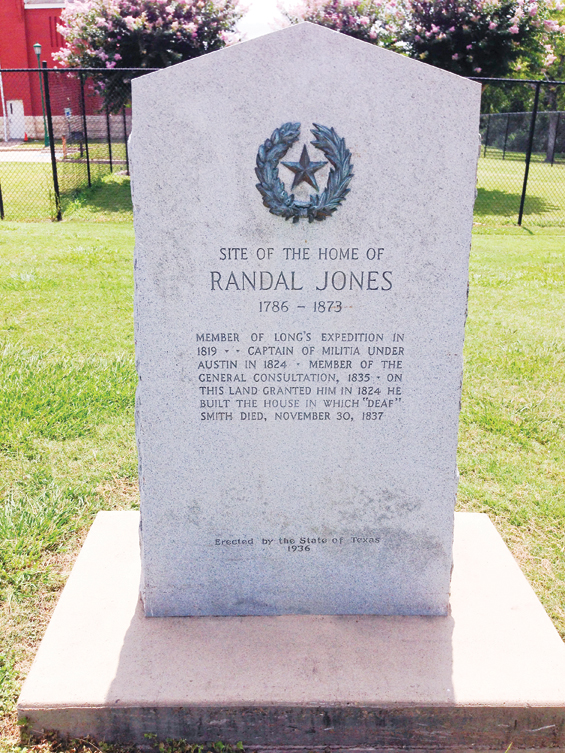
The Randal Jones historical marker in Wessendorff Park in Richmond. The marker states this land is the site of his house, but local historians believe it was actually north of the park.
One of the earliest of the Old 300 to step on Texas soil was Randal Jones. He was born in Georgia in 1786 and his family moved to Mississippi in 1810. He enlisted as a private in the U.S. Army during the War of 1812 and remained in the army until 1814 when he was honorably discharged as a Captain, a title to which he was referred for the rest of his life. He met with remnants of the Gutierrez-Magee Expedition, an ill-fated attempt to separate Texas from Spanish rule, but chose not to associate with that venture. Instead, he established a store at Natchez in 1815 and was soon trading with the Comanche in west Texas. The next year, he had established himself at Nacogdoches.
In 1818, Jones traveled to Galveston to meet with Jean Laffite about purchasing slaves to sell in Louisiana. Before he could embark on this enterprise, Jones became associated with Dr. James Long’s attempt to seize Texas. After Dr. Long’s death, Randal and his brother James escorted Jane Long to San Antonio in 1822 to ask for support after the death of her husband. Later that year he came to Austin’s Colony, settling near the fort in the bend after spending about a year at San Felipe. Randal received a league on the north side of the Brazos at the bend where he raised cattle, and a labor on the other side of the river south of the bend where he made his home. Deaf Smith passed away there in 1837 and Wyly Martin did the same in 1842. Randal was friends with many of the early settlers.
Randal Jones married Mary Andrews, daughter of William Andrews, another Old 300 colonist, in 1824. Randal was 38 and Mary was 16. Later that year, he led a militia to fight a group of Karankawa that had been attacking settlements. The militia defeated the Indians at a creek in Brazoria County that later was given his name, Jones Creek. Randal and Mary had nine children: five girls and four boys. Mary died in 1861. In the later years of his life, Randal Jones was blind. He lived at the Houston home of his son-in-law Gustave Cook when he died in 1873. Presumably, both he and Mary were buried on their land in Richmond. However, in 1934 their remains were moved to the State Cemetery in Austin.
Bibliography:
Sowell, Andrew Jackson. History of Fort Bend County. Houston: W. H. Coyle & Co., 1904. Reprint, Virginia Beach, VA: The Donning Company, 2014. Spellman, Paul N. Old 300: Gone to Texas. San Bernardino, CA: by the author, 2014. Wharton, Clarence. History of Fort Bend County. San Antonio: The Naylor Co., 1939. Reprint, Austin: Eakin Press/Sunbelt Media Inc., 2001.
Historical facts and photos courtesy of the Fort Bend County
Museum Association, Richmond, TX